In compliance with a recent U.S. Treasury (OFAC) regulatory change, TOEFL and GRE testing within Iran has been paused effective immediately. Iranian nationals may continue to test outside Iran where testing is available. Affected test takers will be contacted directly regarding cancellations and next steps. [Find out more]
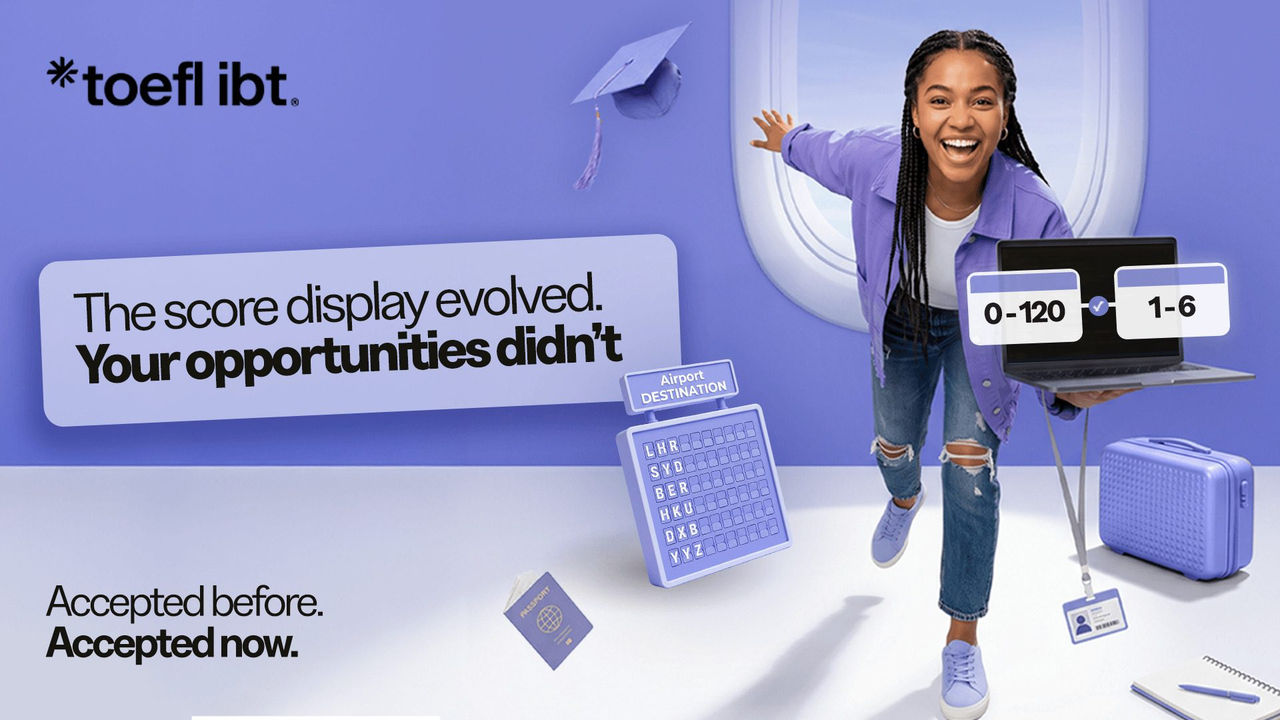
This January, the TOEFL iBT team introduced a suite of updates to the exam, including faster score turnarounds, modernized topics and tasks, and a new score scale from 1 to 6, in increments of 0.5, for the four test sections and the total score.
We believe this better positions TOEFL iBT to offer a consistent, globally relevant, and fairly interpretable score scale for our core stakeholders – institutions seeking to admit students and professionals who speak English as a second language.
But we also know that any update requires consistent communication to ensure test takers and institutions are well informed. Listed below are answers to some frequently asked questions we’ve heard from global test takers.
What scores will I see on my score report?
Through January 2028, every test taker will receive the updated 1-6 score format (total and section scores) and a comparable estimate of an overall score on the 0-120 scale on their official TOEFL iBT score report.
Why are university websites showing different TOEFL iBT score formats?
Universities are updating their websites, admissions pages, and internal materials at different speeds during this two-year transition window. That means one university may display an older 0-120 requirement, another may display a 1-6 requirement, and another may display both. This is expected during the transition period.
Over the next few months, we anticipate an acceleration in universities’ posting of updated 1- 6 scores. As always, to gain certainty, we recommend checking each individual school’s current TOEFL iBT score guidance.
Does this affect TOEFL iBT acceptance?
No. The TOEFL iBT test continues to be accepted by 13,000+ institutions worldwide. If a university website only shows a 0-120 requirement, that does not mean TOEFL iBT acceptance has changed. It usually means the university is undergoing the process of updating their internal systems and public guidance.
Do students need to convert their score?
No. TOEFL provides both formats automatically. Students should continue submitting their official TOEFL iBT scores as normal and follow the admissions guidance provided by each institution. To view comparison tables for section scores, see the TOEFL website.
Why did TOEFL iBT change the score scale?
Today, the Common European Framework of Reference for Languages (CEFR), which offers a transparent, comprehensive language framework with six main proficiency levels from A1 to C2, has become the global standard for English teaching and assessment.
In response, ETS researchers ensured that CEFR score mapping was directly integrated into the development of the 1 – 6 score scale, as opposed to treating it as a subsequent step, to better support interpretation of TOEFL scores in relation to the CEFR levels.
This direct integration has allowed us to draw a more intuitive alignment between TOEFL iBT scores and global norms, while also offering a clearer connection to students’ prior learning and assessment journeys, which are often guided by CEFR.
As a result, students, teachers, and institutions can draw clearer parallels between prior English training and TOEFL iBT results, allowing our exam to mesh naturally with how English is taught and assessed in most global settings.
Key takeaway
The score display evolved. Your opportunities didn’t. Whether a university shows 0-120, 1-6, or both, 13,000+ global institutions still accept the TOEFL iBT test. We recommend checking each institution’s public guidance for up-to-date score requirements.


Copy URL to clipboard
Related
TOEFL Test Prep and Tips
Understanding TOEFL iBT Score Displays in 2026
See FAQs about the TOEFL iBT score scale transition from 0-120 to 1-6 format and what it means for test takers and institutions.
June 11, 2026
TOEFL Test Prep and Tips
How to study with Tina’s album: A track-by-track guide
June 2, 2026
TOEFL Test Prep and Tips
Tina’s Myth-Busters: What Students Think About the TOEFL iBT Test vs. What’s Actually True
May 6, 2026
TOEFL Test Prep and Tips
Meet Tina's Study Album: The Playlist That Works Like a Study System
Struggling to focus? Discover Tina’s science-backed study playlist designed to help you enter deep focus and stay productive during TOEFL test prep.
April 21, 2026

TOEFL Test Prep and Tips
The Ultimate 3-Month Study Plan for the TOEFL iBT® test (2026)
Prepare for the TOEFL iBT® 2026 with this complete 3-month study plan. Improve your skills, build confidence, and achieve your target score.
March 31, 2026

TOEFL Test Prep and Tips
Validity by Design: Measuring Academic English That Matters
Explore how TOEFL uses authentic academic tasks and a validity-by-design approach to measure real-world English proficiency.
February 11, 2026
TOEFL Test Prep and Tips
How TOEFL is Evolving to Serve Today’s English Learners
See how TOEFL continues to evolve the TOEFL iBT® test through research-driven innovation, adaptive testing, and modernized academic tasks.
February 6, 2026

TOEFL Test Prep and Tips
How to Reschedule Your TOEFL Exam: A Brief Guide
Learn how to reschedule your TOEFL iBT exam step by step, including deadlines, fees, refund policies, and common reasons for changing your test date.
January 28, 2026

TOEFL Test Prep and Tips
Common TOEFL iBT Mistakes You Should Avoid
Discover the most common TOEFL iBT mistakes students make before and during the test and learn practical strategies to avoid them.
January 21, 2026

TOEFL Test Prep and Tips
TOEFL Home Edition vs Test Center: Which option is best for you?
Breaking down the difference between the TOEFL Home Edition and test center experience
January 6, 2026

TOEFL Test Prep and Tips
20 Proven TOEFL Tips & Tricks to Score 100+
Achieving a top score in your TOEFL exam can open doors to many new opportunities, including admission to top universities, scholarships, and new career options.
November 11, 2025

TOEFL Test Prep and Tips
What Are The Best Tools to Use For Your TOEFL Test
Discover the best tools to prepare for the TOEFL iBT test.
October 7, 2025

TOEFL Test Prep and Tips
How to Feel Confident Going Into Your TOEFL Test
Boost your TOEFL confidence with proven tips, practice strategies, and mindset shifts to perform your best on test day.
August 27, 2025

TOEFL Test Prep and Tips
The Smart Way to Prepare for Your TOEFL Test (Without Burning Out)
Preparing for your TOEFL test? Use these study tips to get the most out of your sessions and avoid burnout.
August 12, 2025

TOEFL Test Prep and Tips
What is the best way to study for TOEFL at home?
Learn effective study strategies for the TOEFL iBT Home Edition. Discover how to create a study schedule, master each test section through targeted practice, and use resources like TOEFL TestReady to build English proficiency and boost your test day confidence.
June 11, 2025

TOEFL Test Prep and Tips
Can I Take My TOEFL Test Online?
Yes! The TOEFL iBT is offered both online, with the Home Edition, and in test centers, allowing test takers to choose where they feel most comfortable.
June 6, 2025

TOEFL Test Prep and Tips
6 Tips for Retaking the TOEFL iBT Test
If you didn’t reach your score objective the first time around, don’t panic – follow these prep tips to help get your best scores.
October 10, 2024

TOEFL Test Prep and Tips
Prepping for TOEFL: The Debate Between Preparation and Cramming
Prepping for TOEFL: The Debate Between Preparation and Cramming
October 10, 2024

TOEFL Test Prep and Tips
10 Tips for Test-taking Anxiety
Learn how to reduce test-taking anxiety and stress as you study to take your TOEFL iBT test.
June 17, 2024